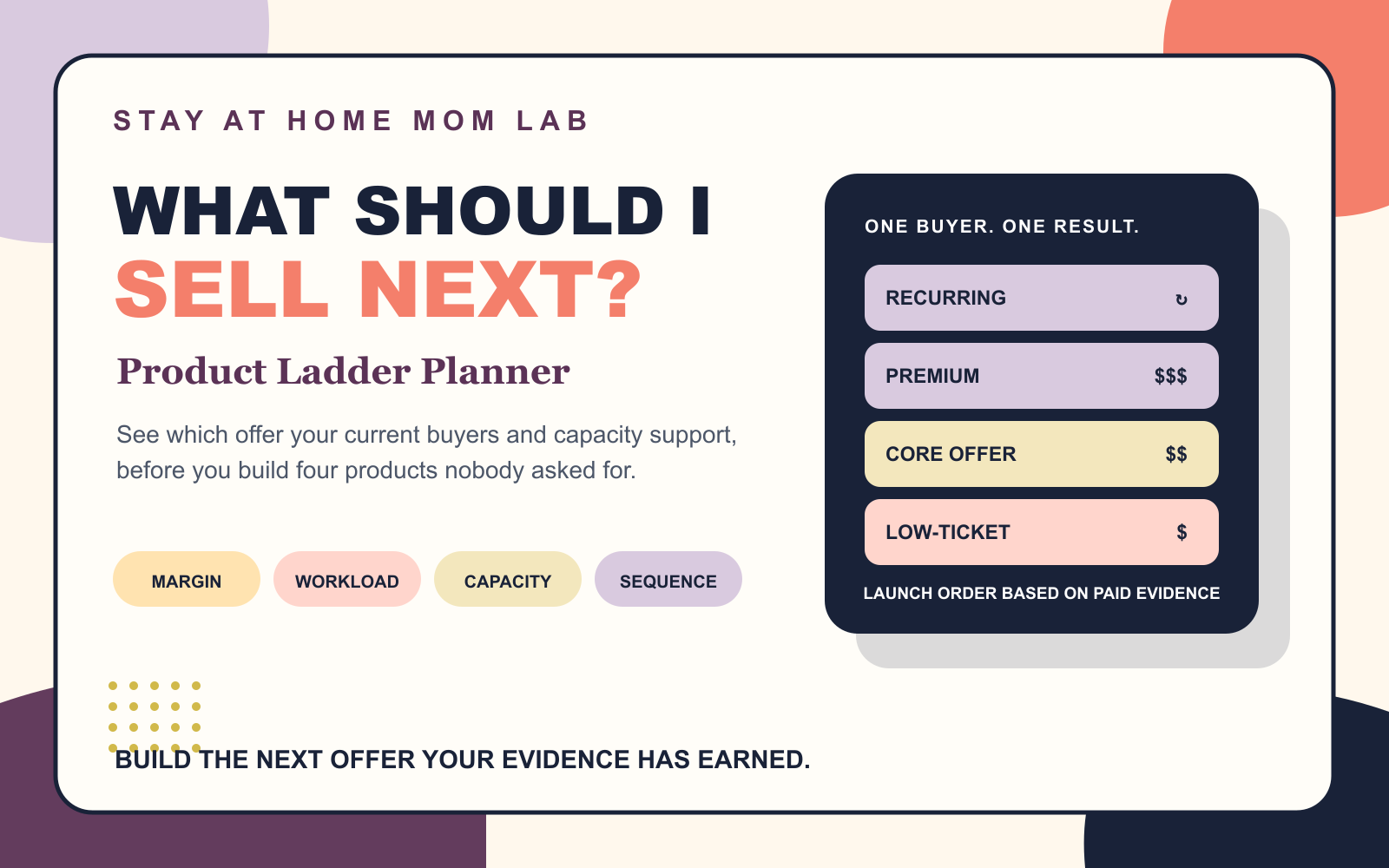
Your first product does not need three random companions. Build the next offer your buyers and capacity support.
Map possible low-ticket, core, premium, and recurring offers around one buyer and one connected result. See contribution after labor, margin, monthly workload, capacity risk, launch order, and an optional order bump that stays useful, clearly priced, and unchecked by default.
Secure checkout and immediate delivery through Gumroad. Digital product. All sales are final except where required by law.
Made to produce a decisionNot another file that leaves you wondering what to do next.
Choose the next tierSeparate low-ticket, core, premium, and recurring offers by the different job each should perform.
Check the workloadCompare contribution after labor and assumed monthly delivery hours with the capacity you actually have.
Sequence from evidenceUse current paid demand and repeat customer need to decide what deserves a pilot now and what stays later.
Why this is useful
A $29 sequence check can prevent months spent building the wrong next product.
A product ladder should make the buyer's next decision easier, not create a warehouse of unfinished products for you to market and support. This planner separates each possible tier by job and refuses to treat an unproved recurring idea as dependable monthly revenue.
Start from one buyer and one connected result so the next offer serves a real progression instead of a new audience you must find from scratch.
See whether price, cash cost, hands-on time, assumed volume, and available hours make the tier workable before building it.
Let paid evidence determine the launch order, beginning with a small core pilot when no paid core offer exists.
Write an optional order bump only when the add-on solves an adjacent problem for the same buyer at the same moment.
What you receive
Everything has a job. Everything points toward action.
01
Four editable offer roles
Map a low-ticket, core, premium, and recurring possibility around the same buyer result.
02
Per-sale contribution math
Subtract cash cost and the value of delivery time from each price before comparing the tiers.
03
Monthly workload scenarios
See assumed monthly contribution, hands-on hours, and total capacity pressure from the volumes you enter.
04
Automatic warnings
Catch negative contribution, weak differentiation, excess workload, and recurring offers without a proved repeat need.
05
Evidence-based launch order
Receive a sequence based on whether the core offer has no paid evidence, one pilot, or repeat paid demand.
06
Respectful order-bump copy
Generate a clearly priced adjacent add-on prompt that must remain optional and unchecked by default.
How it works
Use it in a clear sequence.
1
Name one buyer and result
Keep every possible tier connected to the same customer and a logical progression of value.
2
Map the four possible jobs
Enter the promise, price, costs, time, and volume assumptions for each tier you are considering.
3
Compare money with capacity
Review contribution, margin, workload, warnings, and recurring-need risk before accepting the scenario.
4
Build only the next earned tier
Follow the launch order, gather paid evidence, and leave later tiers as possibilities until their turn.
This is for you if
You have one offer or product idea and keep wondering what else belongs beside it.
You want a low-ticket, core, premium, or recurring path without building all four at once.
You need to compare price and margin with delivery and support capacity.
You want an order bump that raises value without sneaking an item into the cart.
This is not for you if
You want the tool to predict demand, sales, conversion, revenue, profit, or income.
You want to launch four untested offers at the same time.
You want recurring revenue without evidence of a repeat customer need.
You plan to preselect or hide the price of an order bump.
Before you buy
Clear answers, without hiding the limits.
Do I need four products to use this?
No. The tool helps you examine four possible roles. Its launch order may tell you to test only a small core pilot and leave the other tiers unbuilt.
Does the monthly contribution number predict revenue?
No. It is a scenario based on the price, costs, labor value, and sales volume you enter. It does not predict demand, sales, refunds, taxes, fees, conversion, or income.
Can it create an order bump?
It drafts a clearly priced prompt when the low-ticket item provides an adjacent outcome. The add-on must remain optional, relevant, and unchecked by default.
Where are my business numbers stored?
The tool runs offline in your browser. Your entries stay on that device unless you choose to download a backup or export.
Important: Sales volume, margin, contribution, and workload are scenarios based on the numbers entered. They are not demand, revenue, profit, conversion, tax, or income forecasts. Verify fees, refunds, delivery time, support load, laws, taxes, claims, and buyer behavior.